Live
ORBITA Audio
Plugins and instruments built inside the school, for making your own music. Five ready, in students’ hands.
Four bodies in orbit, locked to the tempo at 124 BPM: the motion that drives MATRIX and NEPTUNE. Bring the cursor close and your mass bends the field.
The SCOPE & PROBE proof
See the fight
You think in notes; an ordinary analyzer thinks in hertz. Here a kick and a bass play live, each drawn over the keyboard, and the region where both fight for the same band lights up. That is what SCOPE does in your session.
A kick on every beat and a bass on low E, G and A, at 124 BPM, synthesized live in your browser by the ORBITA Music Lab audio engine. Each voice goes through its own analyzer; the drawing shows both spectra over the keyboard and lights up where they fight for the same band. It plays for about 23 seconds, and only when you ask.
The MARS proof
A bass that knows the note
MARS splits its own sound into layers with separate jobs: sub, body and attack, and the borders move with the note. Here a bass line plays live; change the key and watch each layer react, with the kick sitting in the space left over.
Melodic techno at 122 BPM: a kick on every beat and a bass line walking through E, G, A and B, synthesized live in your browser by the ORBITA Music Lab audio engine. The bass goes through its own analyzer and the screen splits its energy into three bands locked to the note: sub, body and attack. Change the key while it plays. It lasts about 24 seconds, and only when you ask.
The ONE — FIRST LIGHT proof
Every note is a star
Almost every synthesizer teaches synthesis by table: a source, a destination, an amount. ONE swaps the table for a field you touch and see. Here an arpeggio lights a star; move HEAT, MOTION, GRAVITY and ECLIPSE and the sound and the star change together, from the same data.
An E-minor arpeggio at 120 BPM, synthesized live in your browser by a miniature solar engine: two saws and a sub per note, filter, saturation and convolution reverb with an impulse generated on the spot. HEAT opens the filter and saturates; MOTION puts a slow oscillator on the filter; GRAVITY is the space; ECLIPSE cuts the lows and, from 82 % (totality), opens the corona. The star is drawn from the sound and the field. It lasts about 16 seconds, and only when you ask.
The MATRIX proof
Modulation in plain sight
Every synthesizer has modulation; it almost always hides in a menu. MATRIX puts modulation up front, in a single grid. Here the grid is real: connect a source to a destination, hear the difference and see the motion drawn. And compare the LFO, which repeats the same, with the orbit, which rushes near the focus and never comes back the same way.
| Source | Filter | Pitch | Volume | Stereo |
|---|---|---|---|---|
| LFO · sine, 1 bar | ||||
| Orbit · ellipse, 2 bars |
An A-minor phrase at 124 BPM, synthesized live in your browser: sawtooth and a square wave an octave below, filter, volume and stereo position. Two modulation sources locked to the tempo: a one-bar sine LFO, which repeats the same, and a two-bar body in an elliptical orbit, which rushes near the focus, slows far away and is nudged by a second body, so every lap comes out different. Eight possible connections: source to filter, pitch, volume or stereo. It lasts about 15 seconds, and only when you ask.
The NEPTUNE proof
An echo that never stays put
An ordinary delay repeats the sound in the same place, at the same time, until it fades. In NEPTUNE, the echo time, the brightness of the repeats and their place in the stereo field follow four orbiting bodies, locked to the tempo. The bet that this sounds less mechanical than an LFO is still being tested; that is why the Ref. button swaps the orbits for a sine so you can compare. Here too.
On, it swaps the orbits for a sine LFO with the same periods: the experiment’s reference.
How much echo comes in. With percussion the manual asks for under 35 %, or the attack disappears.
A sparse A-minor pluck at 120 BPM, synthesized live in your browser, through a feedback delay; inside the loop, a low-pass filter; on the echo output, the stereo position. Four bodies in elliptical orbit, locked to the tempo, move the echo time (around the dotted eighth), the brightness, the place and the space; each is nudged by the others, so no lap comes out the same. Changing the echo time live changes the pitch of the repeats, as in the plugin. Ref. swaps the orbits for sines. It lasts about 16 seconds, and only when you ask.
What it is
ORBITA AUDIO is ORBITA’s audio technology front: plugins and instruments built inside the school, by those who teach and those who learn.
How a product is born
Every tool starts from a real need in the classroom or the studio, is built in our own code, and is tested by students and teachers before anything else.
What can be said today
The five plugins of the FIRST ORBIT collection are ready, in beta, and already in the hands of ORBITA Academy and ORBITA Community students: ORBITA ONE — FIRST LIGHT, ORBITA MATRIX, ORBITA SCOPE & PROBE, ORBITA NEPTUNE and ORBITA MARS. There is no price and no store. SCOPE & PROBE is the front door, for everyone; the other four come with the Academy and the Community, as tools for the original music the school has always encouraged. Production racks and sample packs are in development.
Products
FIRST ORBIT collection · version 0.1.0-beta.2
The five plugins of the FIRST ORBIT collection, in beta, are already in students’ hands. No price and no store: SCOPE & PROBE is the front door, for everyone; the other four come with the Academy and the Community.
Tools for making your own music: the school’s foundation. Whoever joins the Academy or the Community receives the plugins as part of the path to creating.
Live
ORBITA ONE — FIRST LIGHT
v1.1.0 · beta
Solar-field synthesizer: every note is a star. HEAT, MOTION, GRAVITY and ECLIPSE change the physics of the field, and you see the cause of every change.
For Academy students and Community members
Download: the channel is being set up. For now, students receive it through ORBITA’s channels.
Live
ORBITA MATRIX
v3.2.0 · beta
Three-oscillator synthesizer with the Gravity Engine and a patchbay where every modulation connection is in plain sight.
For Academy students and Community members
Download: the channel is being set up. For now, students receive it through ORBITA’s channels.
Live
ORBITA SCOPE & PROBE
v0.5.3 · beta
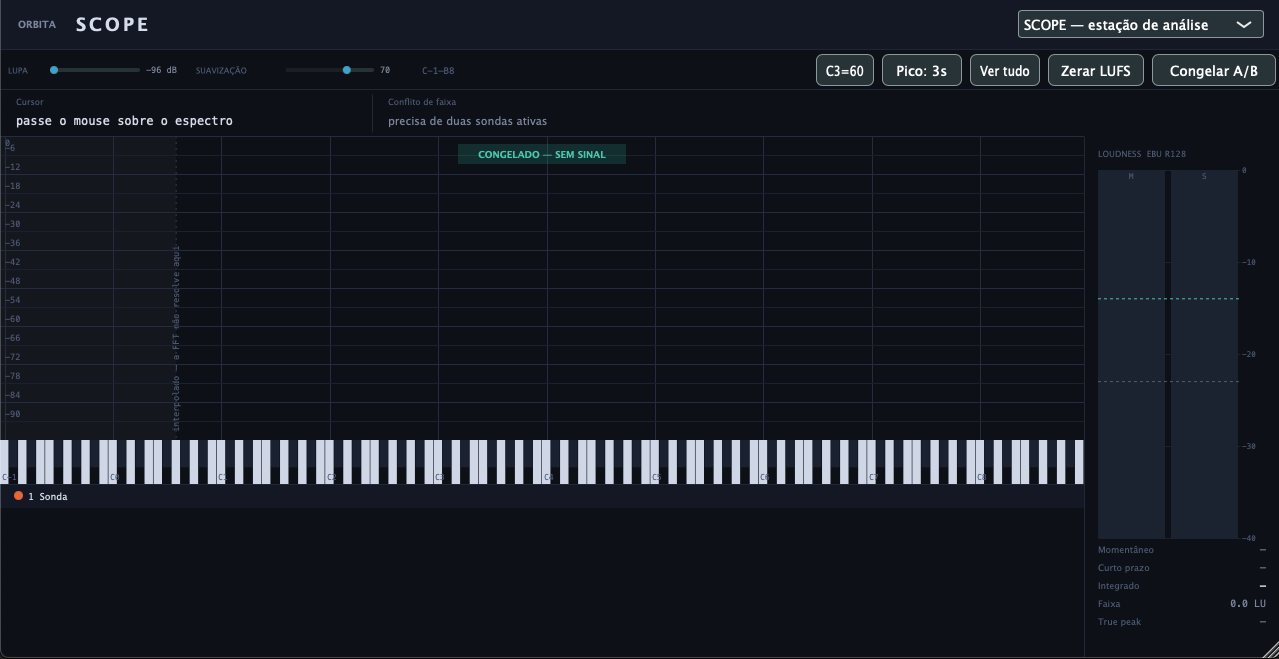
Musical spectrum analyzer: shows frequency as notes and reveals where your instruments fight each other.
Free, for everyone
Live
ORBITA NEPTUNE
v1.1.1 · beta
Space-and-motion rack: delay, diffusion and space driven by four orbiting bodies, at the tempo of your music.
For Academy students and Community members
Download: the channel is being set up. For now, students receive it through ORBITA’s channels.
Live
ORBITA MARS
v0.8.0 · beta
Mono bass that knows the note it is playing: sub, body and attack in separate layers, with room for the kick.
For Academy students and Community members
Download: the channel is being set up. For now, students receive it through ORBITA’s channels.
In development
Racks de produção
Effect and instrument chains for Ableton Live, built in class. In development.
Mac (Intel and Apple Silicon): VST3 and Audio Unit. Windows 64-bit: VST3. Beta version: for studies and productions inside ORBITA Academy and ORBITA Community.
Get ORBITA SCOPE & PROBE
A gift to test: the analyzer that shows frequency as notes and where your instruments fight. Leave your email and we send the installer link for your system, with the installation guide.